When the Printed Programme Became a Listener’s Companion
See how a printed concert programme can guide attention, explain a sequence and become a useful keepsake without competing with the music.
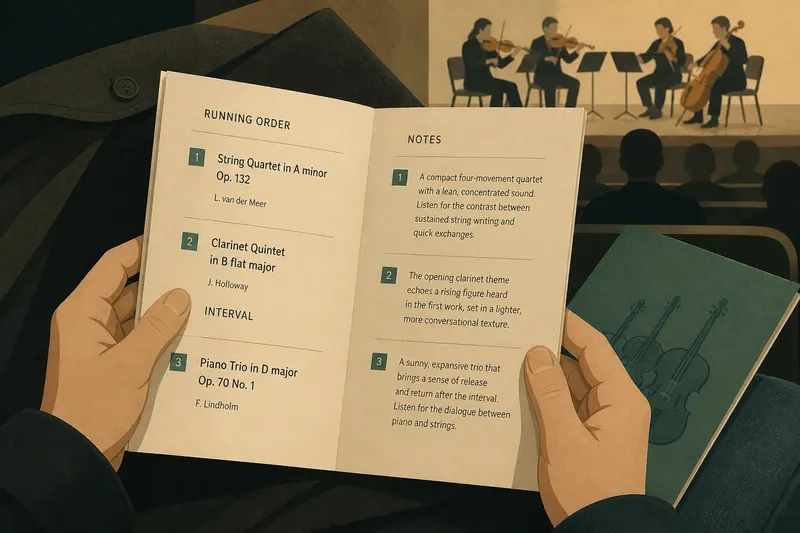
Imagine you arrive at a concert with a folded printed programme in your coat pocket. Before the first note, it tells you what will be played; by the interval, you have used it to notice a link between two pieces; on the way home, it carries a memory of the evening. This invented situation shows how the concert programme grew beyond a list of titles into a companion for listening.
A list answers the first question
At its simplest, a programme names the works, performers and order of a concert. That information matters: it helps listeners recognise what is beginning, see who is on stage and understand where an interval falls. A bare list can still serve well, particularly when the music is familiar or the event needs little explanation.
But a list leaves many questions open. A title may be unfamiliar, a work may have several movements, or a programme may place pieces together in a way that seems surprising. A short note can give the listener a foothold without turning the concert into a lecture.
In the imagined concert, the programme first gives the essential facts in a clear, scannable order. The listener can look down briefly, find the current work and return attention to the stage rather than searching through dense prose.
Context makes unfamiliar music easier to approach
Context does not need to explain every detail. A concise note might identify the kind of work, point out a distinctive instrument or describe what to listen for in broad terms. The aim is orientation: enough information for a listener to enter the music, not a verdict on what they should feel.
For instance, a note might say that a piece moves between a sustained string texture and short exchanges among the instruments. That gives the ear a possible thread to follow. It does not require the listener to identify every exchange or agree with an interpretation.
The hypothetical listener reads this note before the performance, then folds the programme closed. During the music, the suggested contrast becomes one available point of attention; the listener remains free to attend instead to rhythm, tone, the room or something less easy to name.
Sequence can turn separate works into an evening
A programme is also an arrangement. The order can shape how listeners experience contrast, return and change: a brisk work after a reflective one may feel especially vivid, while a later piece can cast a fresh light on something heard earlier. The printed page makes that sequence visible before the concert begins.
Short linking notes can explain an intentional connection, such as a shared instrument or a change in scale. They should distinguish a genuine programme relationship from a coincidence of mood. If no link is intended, the order itself may be all the explanation the audience needs.
In this invented case, the second work uses a musical texture that echoes an element introduced in the first, although the pieces are otherwise different. A sentence in the programme draws attention to that echo without claiming the works tell one continuous story. At the end, the listener can recall the evening as a sequence rather than a stack of unrelated titles.
Design decides whether a programme is usable
Useful writing can be lost on a crowded page. A readable programme separates the running order from the notes, gives performers’ names a consistent place and uses headings that can be found at a glance. Legible type and uncluttered spacing help someone consult it in a dim hall without prolonged page-turning.
For a small chamber concert, a folded leaflet might put the running order on the first page and short notes inside. A longer orchestral programme might use a contents panel or clear dividers. The format should suit the event and the amount of material, rather than asking the audience to work out where each piece is described.
The imagined listener finds the current work quickly because its title is repeated beside the relevant note. That small design choice reduces the effort of consulting the programme and makes it easier to put down again.
What should a concert programme include?
Should every work have a note?
Not necessarily. A note is most useful when it adds context that the title and running order cannot provide; familiar pieces may need little more than clear identification. Keeping some entries brief also gives the audience room to read selectively.
How long should programme notes be?
Long enough to answer a listener’s likely question, but short enough to consult without losing the thread of the evening. A focused paragraph is often easier to use than a dense block covering background, interpretation and technical detail at once.
When should listeners read the notes?
Before the concert or during a pause are natural moments, but there is no required method. A listener can read a little in advance, leave the page closed during a performance and return to it afterwards.
What makes a printed programme worth keeping?
Names, dates, the running order and a few distinctive notes can help someone remember what they heard. A programme becomes a useful keepsake when it records the particular evening clearly, rather than relying on decorative material alone.
A programme can travel beyond the hall
After the invented concert, the listener takes the leaflet home. Its notes help recall which work came first and what contrast had stood out; the performer list also preserves details that might otherwise blur. The programme has not replaced memory, but it gives memory something specific to attach itself to.
That afterlife depends on restraint. A page packed with promotional copy or lengthy commentary may be less inviting to revisit than one that keeps the concert’s identifying details together. A printed programme can also sit beside a digital version, but the paper copy has a particular ease: it is already in the hand, does not need a screen and can be marked or folded.
The best companion leaves room for listening
In the hypothetical situation, the programme began as a list, offered context at the right moments, made the sequence legible and remained useful after the final sound. Its value came from supporting attention rather than directing it. That is the central lesson of the printed concert programme: provide enough detail to make the music easier to enter and remember, then leave the listener free to hear it in their own way.
For anyone choosing what to include, the main search is not for the fullest explanation but for the most helpful one. A printed concert programme works as a listener’s companion when its information is clear, its notes are purposeful and the page is easy to set aside.