Soloist or Ensemble: Where to Place Your Attention
Learn how to listen to a concerto by following its soloist or ensemble, and hear how their contrasting roles shape the music as it unfolds.
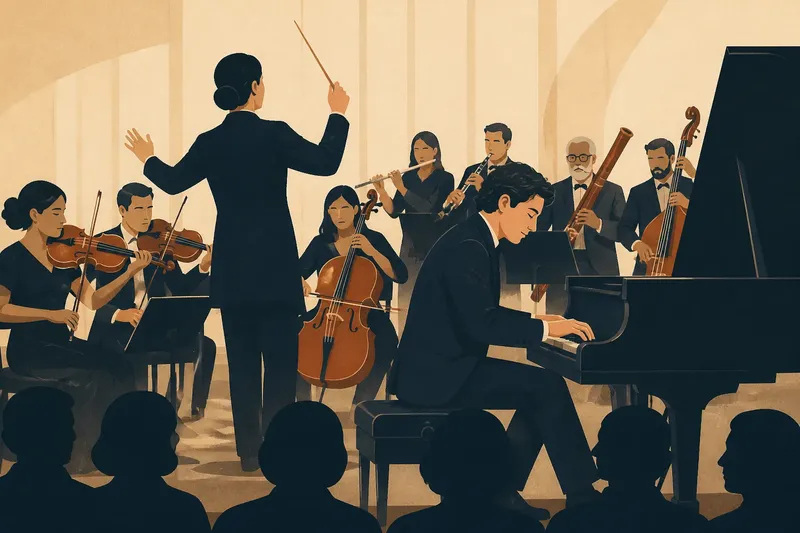
How should you listen to a concerto: stay with the soloist, or turn your attention to the orchestra? Listening to a concerto becomes more revealing when you choose one part at a time and notice how the soloist and ensemble share, exchange or contrast musical ideas.
You do not need to recognise every instrument or read a score. Pick out a sound you can follow, then change your focus when the music offers a clear cue. This approach makes the concerto’s distinct roles easier to hear without asking you to catch every layer at once.
Begin with the orchestra’s role in the opening
If the concerto opens with the orchestra alone, listen for how the ensemble establishes the musical setting. A clear tune, a repeated rhythm or a sustained background can give you a reference point for what follows. Notice which sounds return after the soloist enters and which disappear.
When the soloist begins straight away, listen instead for the orchestra’s first distinct contribution. It might support the solo line with chords, establish a pulse or introduce a contrasting musical idea. You are not trying to remember every detail; the question is whether the ensemble backs the soloist, competes with it or takes the lead.
Hear the soloist as one voice in a shared score
A concerto gives a featured instrument room to stand out, but the soloist is not always the only source of musical direction. A piano may lead a melody while strings mark the pulse; a violin may share a tune with woodwinds; an orchestra may briefly carry the main idea while the soloist rests.
Listen for changes in responsibility. Does the soloist introduce a new idea, decorate a tune already heard, or echo something played by the ensemble? Those relationships matter more than naming every instrument. If you recognise a tune returning in a different sound or register, you have heard the music pass between its players.
Compare how soloist and ensemble shape a passage
Once you have heard a clear solo passage, shift your focus to what the orchestra contributes around it. The ensemble may provide a steady rhythmic base, change the harmony beneath the solo or add a second melody. Each role affects how the soloist’s line comes across: a regular pulse can make it feel free, while a contrasting tune can make the exchange more like a dialogue.
Now reverse the comparison. Listen to an orchestral passage and notice whether its idea resembles anything the soloist has played. This shift is especially useful when the ensemble takes over the melody or when a familiar theme returns in a different arrangement.
Say you are listening to an imagined piano concerto in which the orchestra introduces a short rising tune before the piano enters with a more elaborate version. You recognise the shared outline, then listen to the strings and notice that they sustain chords while the piano adds quick notes above them. The result is a clear distinction: the orchestra supports the harmony, while the soloist reshapes the tune.
When should you shift attention during a concerto?
How can I tell whether the orchestra is accompanying or leading?
Listen for which part carries the main tune and which supports it with rhythm or harmony. If an orchestral instrument takes up the tune while the soloist pauses or changes to a supporting role, the ensemble has become a musical leader in that moment.
What if I cannot identify the instruments?
Use sound qualities rather than names: a bright attack, a smooth sustained line or a low pulse can all help you recognise a part when it returns. You can follow that sound even if you do not know which instrument produces it.
Which moments make the exchange easiest to hear?
Listen when the soloist stops, the orchestra takes up a theme or the texture changes from full ensemble to a more exposed solo. These transitions often make it clearer who has the musical lead and how the other players respond.
Can a recording help me hear both parts?
Yes. A recording lets you revisit a passage and compare the soloist with a particular orchestral layer, such as the strings or winds. Sound balance differs between recordings and concert halls, so treat what is prominent in a recording as one version of the musical relationship.
Let the hall guide your attention without dictating it
Your seat and the hall’s acoustics can affect which parts sound clearest. A solo instrument may seem direct while inner orchestral voices blend into the ensemble; in another space, a rhythmic figure may stand out. Treat what reaches you as a useful clue, not a verdict on the performance.
You can look towards the orchestra when a sound catches your ear, but you do not need to watch every entrance. Listening for a single musical role can be just as useful with your eyes closed or while looking at the score, if one is available.
Make each listening choice reveal a different role
As the concerto unfolds, notice how responsibility moves between soloist and orchestra. The soloist may shape a tune over orchestral chords; the ensemble may take up that tune; or both may contribute contrasting ideas at once. A simple observation about who leads and who supports is enough to make the exchange more audible.
For listening to a concerto, try following the soloist in one passage and the ensemble in another, then compare what each reveals. You may hear a theme change hands, an orchestral layer reshape the solo line or the soloist transform an idea first introduced by the ensemble. The music often makes its structure clearest through those changing roles.